

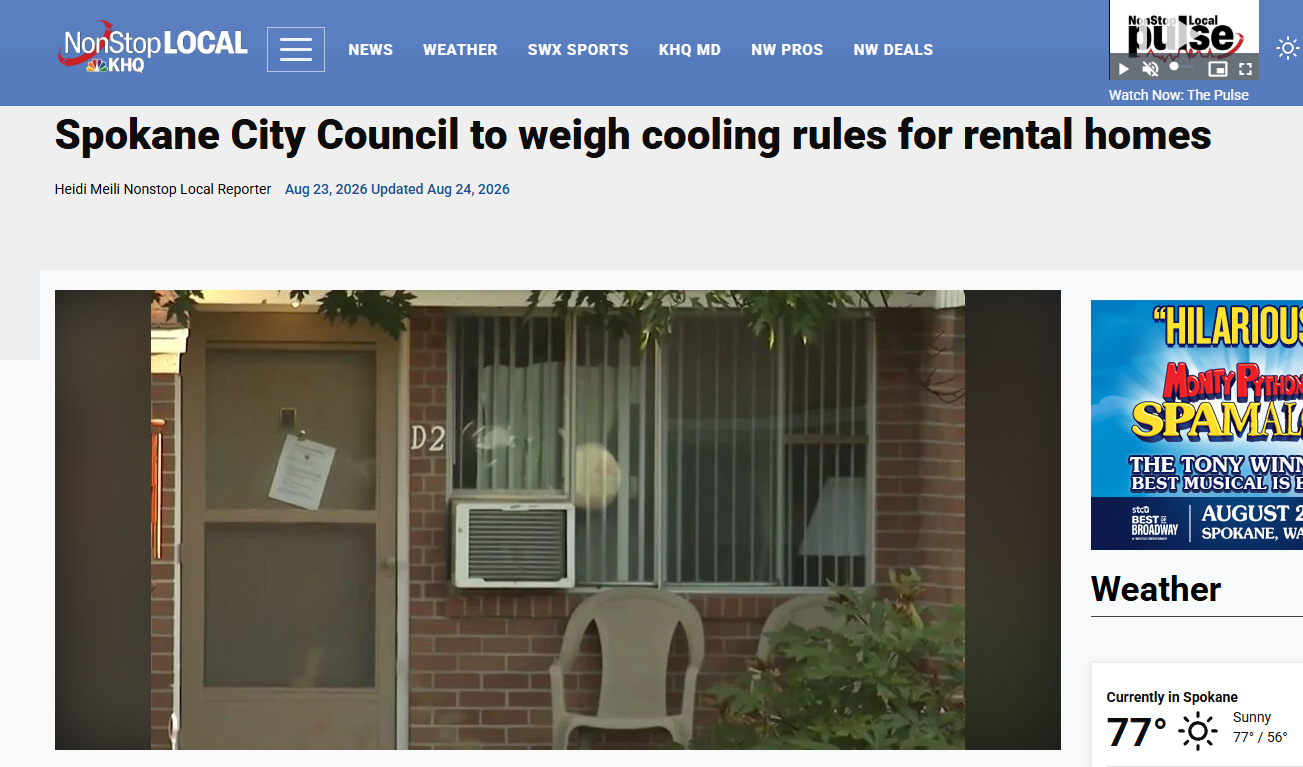
Spokane's New Renters' Right to Cooling Law: What Landlords Need to Know
Last updated: August 2026
If you own a rental inside Spokane city limits, you picked up a new legal obligation this summer, and the clock on some of it is already running.
The Spokane City Council voted 5 to 2 on July 29, 2026 to pass Ordinance C36877, better known as the Renters' Right to Cooling ordinance. Cooling is now a habitability requirement, the same way heat has been for decades.
Most of the coverage has been about the council fight. Here's what owners actually have to do.
First, does this apply to your property?
This is a City of Spokane ordinance, so it covers rental units inside city limits.
Spokane Valley, Liberty Lake, Cheney, Airway Heights, and unincorporated Spokane County are not affected. Neither are Post Falls, Coeur d'Alene, or anywhere in North Idaho. A lot of owners around here hold units in more than one jurisdiction, so check property by property before assuming one answer covers everything you own.
One statewide rule applies everywhere in Washington regardless: landlords can't stop a tenant from installing their own portable cooling unit. That's been in effect since 2024 and is separate from the new ordinance.
What the ordinance requires
Cooling in at least one room, effective now. Every rental dwelling needs adequate cooling in at least one room. This is already active.
A three day response window. When a tenant requests cooling, you have three days to provide it. Three days is a tight turnaround for an HVAC contractor in July, when every other landlord in Spokane is calling the same handful of companies.
Cooling in every bedroom by 2032. By 2032 the requirement extends to each bedroom. You have time, but if renovations or capital work are coming up before then, fold it in so you're not paying twice for the same job.
New construction permitted after January 1, 2027. Anything permitted on or after that date has to include cooling equipment from the start.
Written notice to tenants. You have to notify tenants in writing about their rights under the ordinance. Easiest item on the list to satisfy, easiest to forget.
What counts as adequate cooling?
This is where owners have the most questions, and the standard is looser than most people would like.
Earlier drafts set a hard number: units had to be brought to 80 degrees or below. That threshold got stripped out by amendment before the final vote. What passed defines adequate cooling as cooling sufficient to prevent risks to tenant health.
A health based standard gives you some flexibility. A shaded, well insulated unit needs less equipment than one that bakes all afternoon, and the ordinance now leaves room for that. The tradeoff is there's no bright line to point to if a dispute comes up. If you want an internal benchmark, the original 80 degree figure still works as a target even though it's no longer the letter of the law.
Enforcement rules are still being worked out by city administration, so expect some of the finer points to shift.
What happens if you don't comply
Tenants have two remedies, and both cost you money.
The first is self help with reimbursement. If a unit isn't kept adequately cool, the tenant can buy cooling equipment and deduct up to $500 from rent. That cap rises each July with the Consumer Price Index.
The second is lease termination. Miss the three day window and the tenant can end their rental agreement.
Losing a tenant mid lease means turnover, vacancy days, cleaning, and re leasing costs that will run well past what a window unit would have cost you. The economics here aren't close.
Can you get an extension?
Sometimes. The ordinance allows extensions where providing adequate cooling would create an undue hardship, where compliance would require major building improvements, or where the property sits in a recognized historic building.
Historic buildings matter more in Spokane than they would in a lot of cities. Browne's Addition, Rockwood, and much of the South Hill are full of homes built long before central air was a consideration. Retrofitting ductwork into a 1904 Craftsman is a different project entirely from adding a mini split to a 1990s duplex. If you own an older property and the math looks impossible, look into the extension process before assuming you're stuck.
A practical checklist
Confirm which of your units actually fall inside Spokane city limits.
Walk each unit and note whether at least one room currently has adequate cooling.
Send the written notice to tenants.
Line up an HVAC contractor now, before a heat wave and a three day clock arrive together.
Document everything. Equipment installed, notices sent, tenant requests received, dates you responded. Records are your defense if a dispute comes up.
Put bedroom cooling into your capital planning for 2032.
Look into an extension if you own a historic property or face a hardship case.
Why the law passed
The ordinance was drafted in partnership with the Gonzaga Institute for Climate, Water, and the Environment. The event driving it was the June 2021 Pacific Northwest heat dome, which caused heat related deaths in Spokane County and sent hundreds of people for medical treatment.
The council split on it. Council President Betsy Wilkerson and Council Member Michael Cathcart voted no, arguing that compliance costs would end up passed along to tenants already stretched on rent. The majority said the cost estimates were overstated and the ordinance would save lives.
What is still being decided
The cooling requirement passed in July, but the city hasn't settled how it gets funded and enforced. A council agenda session in late August laid out a phased approach: draw on existing funds first to bring rentals up to habitability, then build a dedicated fund from a share of revenue collected, and eventually cover cooling upgrades or tenant relocation using enforcement fines levied against landlords.
That last part matters if you own rental property here. It means noncompliance may end up funding the program itself.
Cobalt weighed in when KHQ asked for a response to the proposed cooling rules for Spokane rentals. Doc Nicolson, owner of Cobalt Property Management, said the company supports keeping tenants safe during extreme heat but questioned who ends up absorbing the cost. A large share of Spokane's affordable rental housing belongs to small local landlords, not corporations, and many have deliberately held rents below market to keep long-term tenants in place. For an owner with ten or twenty units in older buildings, where electrical upgrades may be needed before cooling equipment can go in, the bill climbs into the tens of thousands. His concern is that fixing one problem risks making "affordable housing even harder to find in Spokane."
For context on the other side of the argument, a recent study found that 23 percent of Spokane residents faced limits on cooling their homes, mostly because of utility costs. That number is a big part of why the council moved, and it will likely shape whatever funding mechanism lands.
Common questions
Do I have to provide air conditioning in my Spokane rental? If the property is inside Spokane city limits, yes. Adequate cooling is required in at least one room now, and in every bedroom by 2032.
How long do I have to respond when a tenant asks for cooling? Three days.
Does a portable AC unit count? The ordinance requires cooling adequate to prevent health risks, not a specific type of equipment. A properly sized portable or window unit will meet the standard in many rooms. Larger or poorly insulated spaces may need more.
Does this apply in Spokane Valley? No. It's a City of Spokane ordinance, and Spokane Valley hasn't adopted an equivalent rule.
What if my building is historic and can't be retrofitted? The ordinance allows time extensions for historic buildings, for cases requiring major improvements, and for undue hardship.
Can a tenant break their lease over this? Yes. If you don't comply within three days of a request, the tenant may terminate the rental agreement.
Not sure where your properties stand?
Notice requirements and three day response windows are manageable when you own one rental. With six, things start slipping through.
Keeping up with regulatory changes across Spokane, Spokane Valley, and North Idaho is part of what we do at Cobalt Property Management for the owners we work with, along with making sure maintenance requests actually get answered inside the window the law allows.
If you want to talk through what this means for your properties, get in touch or call us at (509) 795-1031.
This article is general information, not legal advice. It reflects the ordinance as adopted in July 2026. Enforcement rules are still being finalized by city administration and individual situations vary, so consult a qualified attorney about your specific property. The official text is Spokane Ordinance C36877.
